
Mission
To deliver rigorous medical education grounded in evidence-based practice, clinical competence, professional ethics, and community-centered healthcare.
 PUST · Medicine & Health Sciences
 Training future physicians with academic excellence, clinical competence, and ethical service to community health.
Six-year Doctor of Medicine pathway combining basic medical sciences, skills laboratories, hospital rotations, and community health practice.
Program Overview
A professionally structured programme combining academic rigour, supervised practice, and ethical preparation for graduate careers in health.
The MBBS (Bachelor of Medicine, Bachelor of Surgery) program prepares students to become competent, ethical doctors capable of serving in hospitals, clinics, public health systems, and community settings across Somalia and the region.
To deliver rigorous medical education grounded in evidence-based practice, clinical competence, professional ethics, and community-centered healthcare.
To graduate physicians who lead with compassion, scientific rigor, and commitment to improving health outcomes in Puntland and beyond.
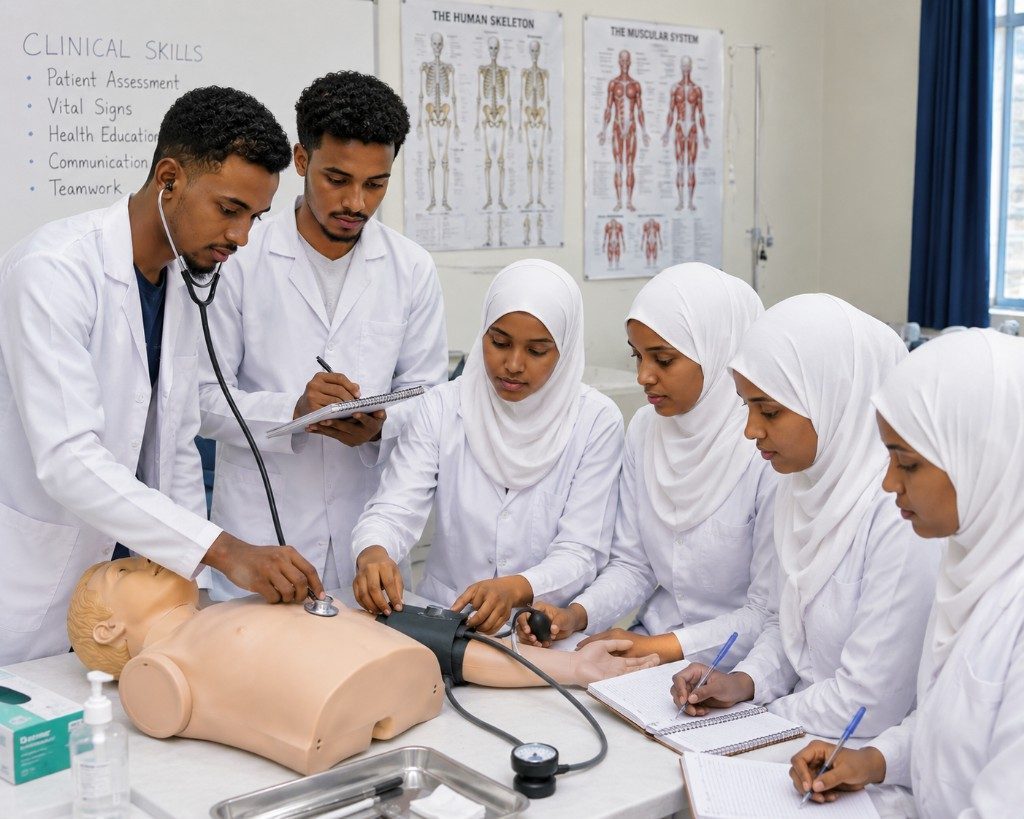
Students learn through lectures, tutorials, case discussions, anatomy and skills laboratories, simulation exercises, and supervised clinical placements.
Modern anatomy, physiology, pathology, and clinical skills laboratories — plus hospital partnerships — connect academic study to real patient-care environments.
Practical training for clinical procedures, patient assessment, and supervised demonstrations.
Scenario-based practice that strengthens clinical decision-making before hospital placement.
Supervised exposure to real healthcare settings through institutional clinical partnerships.
Field practice linking public health priorities with patient and community engagement.
Academic references, digital resources, and research support for medical students.
Academic advising, mentoring, and guidance throughout the medical training journey.
Foundational sciences, anatomy, physiology, biochemistry, and early clinical exposure.
Pathology, pharmacology, microbiology, and applied clinical sciences.
Hospital rotations in medicine, surgery, pediatrics, obstetrics, and community health.
Advanced clinical practice, professional ethics, and service readiness.
Admissions
Follow our unified admissions roadmap. Our enrollment staff are fully dedicated to processing your credentials.
Review our engineering, sciences, and business programs catalog to select your perfect path.
Compile school certificates, high school transcript cards, photos, and passport identity files.
Complete the online PUST enrollment sheet on this platform carefully.
Settle the $20 administrative processing fee at our aligned banking counters or secure portals.
Sit for the fundamental general scientific and mathematical entrance assessment exam on campus.
Receive the formal registrar enrollment certificate package with class schedules.
Secondary school certificate or equivalent with strong performance in Biology, Chemistry, Physics, English, and Mathematics.
Completed application form, academic certificates, passport-size photos, identification document, and any required equivalency documents.
Apply online, submit required documents, complete entrance review or assessment when requested, and confirm admission through registration.
Admission deadlines are announced by the Admissions Office each intake. Early application is strongly recommended for MBBS.
Different degree programs require specific credentials. Select your intended level of study to inspect target registration benchmarks before applying.
Tuition & Fees
| Programme | Duration | Semester Fee | Annual Fee | Registration | Schedule |
|---|---|---|---|---|---|
| MBBS | 6 Years (12 Semesters) | $270 | $540 | $15 | Semester-based payment before registration confirmation |
Clinical Experience
Skills laboratories, simulation, and supervised clinical placements connect academic study to patient-centred care.
6 clinical environments
Practical training for clinical procedures, patient assessment, and supervised demonstrations.
Scenario-based practice that strengthens clinical decision-making before hospital placement.
Supervised exposure to real healthcare settings through institutional clinical partnerships.
Field practice linking public health priorities with patient and community engagement.
Academic references, digital resources, and research support for medical students.
Academic advising, mentoring, and guidance throughout the medical training journey.
Clinical readiness develops through guided practice, ethical supervision, and meaningful exposure to real healthcare settings.
Graduate Outcomes
Graduates enter professional roles across hospitals, community health, public service, research, and further clinical training.
4 graduate pathways
Graduates pursue housemanship, hospital practice, public health service, NGO programs, research pathways, and postgraduate medical specialization.
Student Questions
Quick answers about duration, admission, tuition, and training requirements.
5 common questions
The MBBS program is six years (twelve semesters), including structured academic study and clinical training requirements.
Yes. Clinical rotations and supervised hospital practice are integrated throughout the later years of the program.
Strong performance in Biology, Chemistry, Physics, English, and Mathematics is recommended.
Students normally follow the university payment schedule confirmed during registration.
Use the online application portal and submit all required academic and identity documents before the intake deadline.
Applications now open
Submit your application online. Our admissions team will support you through document review, assessment, and enrollment for the next intake.