Mission
To deliver rigorous engineering education grounded in mathematics, applied science, ethical practice, and hands-on problem solving for real-world challenges.
 PUST · Engineering and Earth Science
 Shaping infrastructure innovators, energy specialists, and earth science professionals for Somalia's development.
Accredited engineering pathways in civil, electrical, systems, and geological sciences — with laboratories, field practice, and project-based learning.
Faculty Overview
The Faculty of Engineering and Earth Science prepares graduates to design infrastructure, power systems, geological solutions, and technology-enabled engineering projects that support national development.
To deliver rigorous engineering education grounded in mathematics, applied science, ethical practice, and hands-on problem solving for real-world challenges.
To be a leading faculty for engineering education, applied research, and technical innovation in the Horn of Africa.
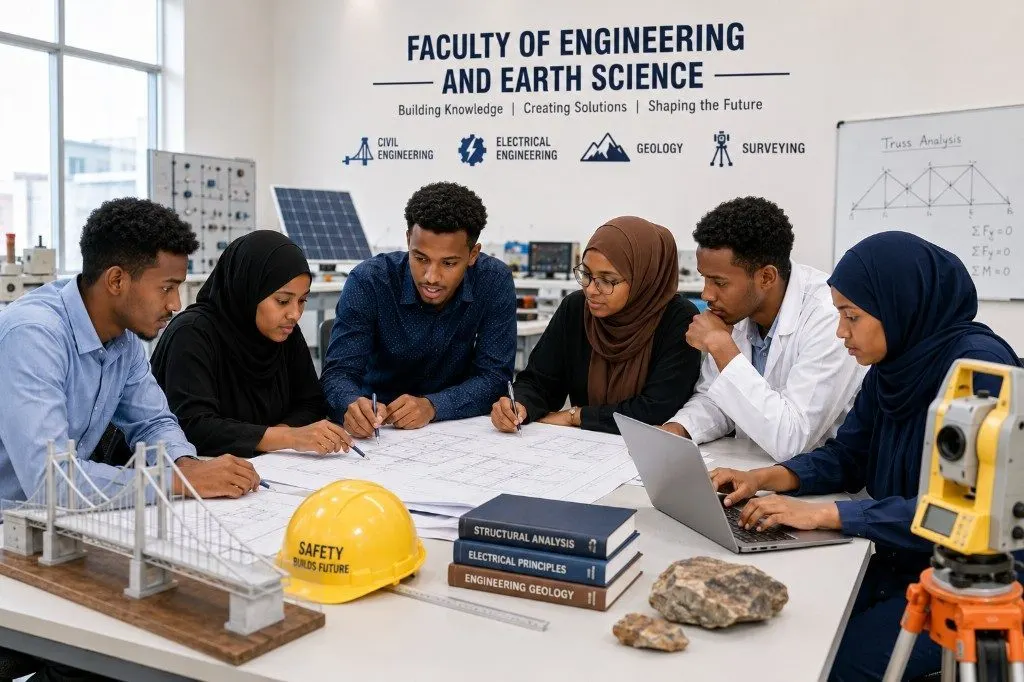
Students learn through lectures, design studios, laboratory sessions, surveying practice, team projects, internships, and mentorship from experienced engineers and scientists.
Structural, electrical, surveying, and geology laboratories — plus computer-aided design tools — connect classroom theory to practical engineering and earth science applications.
Rigorous programs in civil, electrical, systems, and geological sciences — combining theory, labs, fieldwork, and industry-ready skills.
2 programmes offered
Structural design, geotechnical engineering, infrastructure planning, and sustainable construction practice.
Power systems, electronics, control engineering, and renewable energy applications.
Admissions
Prepare your documents early and complete the online application before the announced intake deadline.
Secondary school certificate or equivalent with strong performance in Mathematics, Physics, and English.
Completed application form, academic certificates, passport-size photos, identification document, and any required equivalency documents.
Apply online, submit required documents, complete review or assessment when requested, and confirm admission through registration.
Admission deadlines are announced by the Admissions Office each intake. Early application is recommended for engineering programs.
Tuition & Fees
Semester tuition fees by faculty. Scholarship and special categories are listed separately.
| Programme | Duration | Semester Fee | Annual Fee | Registration | Schedule |
|---|---|---|---|---|---|
| Civil Engineering | 4 Years (8 Semesters) | $300 | $600 | $15 | Semester-based payment before registration confirmation |
| Electrical & Electronics Engineering | 4 Years (8 Semesters) | $300 | $600 | $15 | Semester-based payment before registration confirmation |
Eligible students may apply for scholarship or financial aid opportunities when announced by PUST or partner institutions.
Learning Resources
Students benefit from academic resources, practical learning spaces, and support services designed for professional development.
CAD, drafting, and project planning spaces for structural and systems design coursework.
Circuit analysis, electronics, and power systems practice with guided experiments.
Materials testing, surveying, and structural concepts applied in practical sessions.
Field studies and laboratory analysis supporting geological and environmental learning.
Integrated systems, computing, and control fundamentals for modern engineering practice.
Technical references, standards, and digital resources for engineering study.
Research & Innovation
Faculty-led research, innovation projects, and applied learning initiatives that connect academic study to real-world impact.
Accredited academic pathways
Dedicated lecturers and mentors
Applied learning and discovery
Graduate Outcomes
Graduates pursue careers in construction, energy, mining, telecommunications, public works, consulting firms, NGOs, and government infrastructure agencies.
Student Opportunities
Internships, competitions, mentorship, and student activities that enrich your academic journey at PUST.
Gain practical experience through faculty-supported internships with industry partners, NGOs, and public institutions.
Participate in academic competitions, research showcases, and university-wide recognition programmes.
Join faculty clubs and peer networks that connect learning with leadership and community engagement.
Receive guidance from faculty mentors on academic planning, career direction, and professional development.
Faculty Life
Gallery highlights learning moments across classrooms, labs, projects, ceremonies, and student activities.
Engineering drawings, CAD work, and collaborative design reviews.
Hands-on experiments in electrical, civil, and materials engineering.
Surveying, geology, and site visits that connect theory to terrain.
Team engineering solutions addressing real community and industry needs.
Celebrating engineers ready to build Somalia's future.
Questions
Quick answers for admission, duration, internships, tuition payment, and scholarship questions.
Programs include Civil Engineering, Electrical Engineering, Computer Systems Engineering, Geology, and related bachelor pathways. See the Programs tab for details.
Yes. Laboratory sessions, design projects, and field components are integrated throughout the curriculum.
Strong performance in Mathematics and Physics is recommended. English proficiency is also important.
Most programs follow a four-year bachelor structure. Confirm duration on each program page.
Use the online application portal and submit all required documents before the intake deadline.
Admissions Open
Start your application online or speak with our admissions team about programme options and entry requirements.